
Why does a Passive House retrofit have a higher heating demand than a new build?
Every certified Passive House Carland Constructions has built performs at a level that would make most Melbourne homes look embarrassing. But one of our projects sits noticeably higher on the heating demand chart than the others. Some people see that number and assume something went wrong. Nothing went wrong. That higher number is the most honest thing on the page.
A Passive House retrofit certified to EnerPHit standard has a higher heating demand than a new build because the existing structure imposes physical constraints that can't be fully engineered away. You cannot relocate a 30 year old slab, redesign its footprint, or rotate it north. You can only improve what you have.
Carland Proof Point: The Retrofit Rifle EnerPHit in Williamstown achieved a certified heating demand of 31.5 kWh/(m²a). That is still a 95% reduction on a typical pre-2000 Melbourne home, but higher than the four Carland Constructions new-build Passive Houses, which range from 9.0 to 14.8 kWh/(m²a).
The Retrofit Rifle EnerPHit in Williamstown achieved a certified heating demand of 31.5 kWh/(m²a) — still a 95% reduction on a typical pre-2000 Melbourne home, but higher than our four new-build Passive Houses, which range from 9.0 to 14.8 kWh/(m²a).
What does heating demand actually mean?
Before we get into the numbers, it is worth explaining what this figure actually measures. Heating demand is the total energy the building needs to maintain a comfortable interior temperature of 20°C through the heating season, expressed per square metre of treated floor area, per year. The unit is kWh/(m²a).
In PHPP, the Passive House Planning Package and the energy modelling tool used for all certified Passive House and EnerPHit projects, this figure is calculated using climate data specific to Melbourne, real geometry inputs for the building, measured airtightness results from a post construction blower door test, and the actual thermal performance of every element of the building envelope.
The Passive House Institute sets the threshold at 15 kWh/(m²a) or below for a new certified Passive House. For EnerPHit, the retrofit pathway, the threshold is different. Because existing buildings cannot be engineered from scratch, EnerPHit uses a component method: each element of the building envelope must meet specified U-value targets. The heating demand figure is still calculated and still reported, but it is not the primary certification criterion.
By comparison, according to CSIRO research, the average Australian home built before 2003 sits at approximately 1.8 stars, with no post construction testing of any kind and no energy modelling that reflects what the building actually does. Melbourne homes average 19 ACH50 in airtightness (Australian Building Codes Board, 2016 airtightness study). All five certified Carland Constructions projects came in below 0.5 ACH50.
How do the five Carland Constructions projects compare?
All figures below are drawn directly from the PHPP post-construction certification files for each project. The heating demand figures use the monthly method, which is the primary calculation method in PHPP and the figure used for certification purposes.
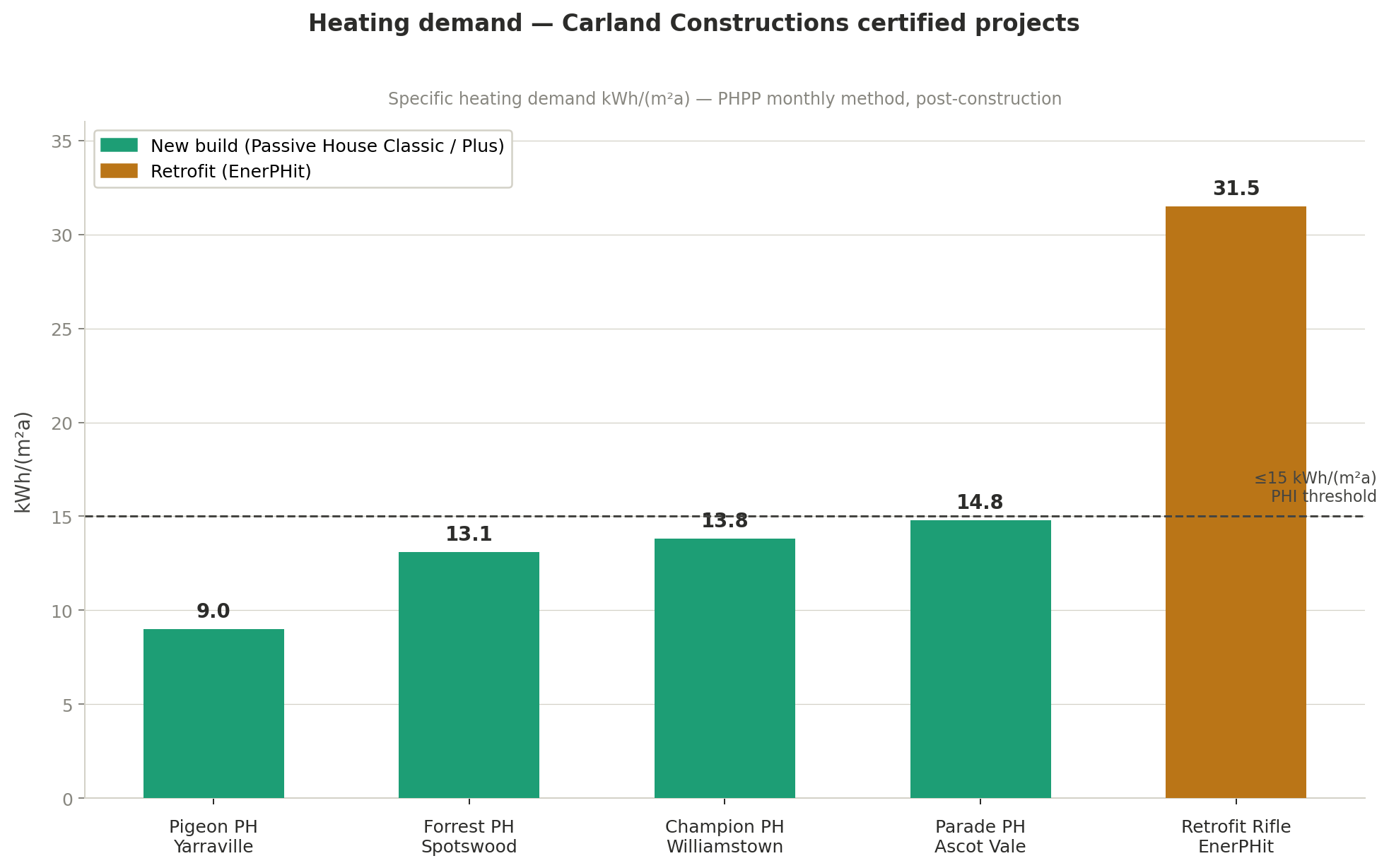
Pigeon Passive House, Yarraville 9.0 kWh/(m²a) | TFA: 151 m² | Airtightness: 0.26 ACH50
The standout performer in the Carland Constructions portfolio. A compact, two-storey timber-framed home on a narrow Yarraville lot. The exceptional result comes down to a combination of extraordinary airtightness, 0.26 ACH50 is well below half the Passive House threshold, a very strong north-facing glazing allocation, and a building form that minimises exposed surface area relative to floor area. The windows carry an average installed U-value of 0.98 W/(m²K). This is the only Carland Constructions project to also achieve a heating load below 10 W/m².
Forrest Passive House, Spotswood 13.1 kWh/(m²a) | TFA: 149 m² | Airtightness: 0.40 ACH50
A timber framed home in Spotswood. The result sits comfortably inside the PHI threshold. Wall U-value of 0.258 W/(m²K), roof at 0.155 to 0.259 W/(m²K) depending on assembly. The Forrest Passive House was one of the earlier certified projects in the Carland Constructions portfolio and demonstrated what can be achieve on a compact Melbourne block.
Champion Passive House, Williamstown 13.8 kWh/(m²a) | TFA: 161 m² | Airtightness: 0.39 ACH50
A single-storey suspended floor home in Williamstown. The suspended floor introduces more complexity to the thermal envelope than a slab on ground build. The floor assembly U-value sits at 0.258 W/(m²K), and the ground heat loss calculation in PHPP accounts for the ventilated subfloor condition. Despite that, 13.8 kWh/(m²a) represents a clean result, well under the 15 kWh/(m²a) threshold. Window U-values average 0.975 W/(m²K) installed.
Parade Passive House, Ascot Vale 14.8 kWh/(m²a) | TFA: 202 m² | Airtightness: 0.49 ACH50
The largest building in the Carland Constructions portfolio at 202 m² treated floor area, and the SIPS-constructed project in the portfolio. The Parade Passive House also integrates with an existing Victorian-era heritage frontage, which constrains orientation and glazing placement in ways a greenfield new build simply doesn't face. The PHPP result of 14.8 kWh/(m²a) is essentially at the threshold. That is not a concern. It is certified, the performance is real, and the blower door test confirmed 0.49 ACH50. What it does reflect is that a larger floor area with a more complex building form and heritage constraints has to work harder for every decimal point.
Retrofit Rifle EnerPHit, Williamstown 31.5 kWh/(m²a) | TFA: 152 m² | Airtightness: 0.43 ACH50
Here is where the conversation gets interesting.
Why is the Retrofit Rifle EnerPHit heating demand more than twice that of the new builds?
The short version: because physics does not negotiate.
When Carland Constructions retrofitted this 30-year-old volume home in Williamstown to a certified EnerPHit standard, the building's location was fixed. Its orientation was fixed. Its footprint, 178 m² of slab-on-ground, was fixed. And critically, the existing concrete slab had no perimeter insulation and could not be retrofitted without excavating the entire perimeter and effectively rebuilding the ground floor. That was not on the table.
Look at the PHPP ground heat loss calculation for the Retrofit Rifle. The slab U-value is 1.045 W/(m²K). Compare that to the Pigeon Passive House's slab at 0.402 W/(m²K), or the Parade Passive House's slab at 0.373 W/(m²K). The Retrofit Rifle slab is conducting heat to the ground at roughly 2.5 times the rate of a purpose-designed new build. Over a Melbourne winter, that difference accumulates into a very large number.
There is also the question of what EnerPHit actually certifies. The standard does not require the retrofit to achieve the same heating demand as a new build. It requires every component of the building envelope that can be improved to be improved to a specified minimum standard. The walls were improved to 0.273 W/(m²K). The roof was improved to 0.247 W/(m²K). New triple-glazed windows were installed with an average installed U-value of 1.25 W/(m²K), which meets the EnerPHit component threshold.
The building also achieved 0.43 ACH50 on the blower door test. For a retrofit, where every penetration through the existing structure is a potential air leak, where the original construction had no airtightness layer, and where each trade had to learn the system on an occupied renovation, that is a genuine achievement.
What PHPP honestly tells you is that even after all of this work, a concrete slab with no edge insulation and a ground contact area of 178 m² in a Melbourne winter is a significant thermal liability. You cannot insulate what you cannot access. So the heating demand is 31.5 kWh/(m²a). That is the real number for a real building under real constraints.
What does EnerPHit certification actually mean?
EnerPHit is not a consolation prize for buildings that couldn't achieve Passive House Classic. It is a rigorous, independent certification pathway specifically designed for the retrofit of existing buildings, developed by the Passive House Institute in recognition that the existing housing stock has its own physics.
The PHI component requirements for EnerPHit adjust to practicable thresholds for retrofits based on what is physically achievable without demolition. Airtightness for EnerPHit is set at 1.0 ACH50 or below, again recognising that an existing structure cannot be made airtight from the outside in the same way a new build can from day one of framing.
The Retrofit Rifle meets all applicable EnerPHit component criteria. Every element of the envelope that could be improved was improved to or beyond the specified thresholds. The certification is independently verified. The blower door test result is a measured, not modelled, outcome.
Over 70% of Australian homes were built before 2000, according to the Australian Building Codes Board. Those homes were built with no airtightness standard, no thermal bridge requirement, no MVHR, and no independent performance verification. EnerPHit exists because that stock is not going away and it needs a certification pathway that is honest about what retrofit can achieve without demolishing the building.
Does the higher heating demand mean the building performs worse for the occupants?
This is the right question to ask, and the answer requires some nuance.
In absolute energy terms, the Retrofit Rifle will consume more heating energy per square metre per year than the new build Passive Houses. That is what 31.5 versus 13.8 kWh/(m²a) means. But compared to what that building was before the retrofit, and compared to what a typical Melbourne home of similar vintage would consume, the improvement is transformative.
The average pre-2000 Australian home has never had a blower door test, sits at approximately 19 ACH50 (ABCB/CSIRO, 2016), has wall insulation that was likely inadequate at install and has since degraded, and has never had an HRV. Its heating demand, if it were ever modelled in PHPP, would likely sit north of 150 kWh/(m²a).
The Retrofit Rifle now has filtered and continuously exchanged fresh air. Its envelope is significantly tighter and better insulated than anything the NCC required when it was built. Its occupants experience a level of thermal comfort and indoor air quality that the original building could not provide. The certification is real. The performance is measured.
The 31.5 kWh/(m²a) figure is not a failure. It is an honest statement of what physics allows when the building cannot be rebuilt from scratch.
What determines heating demand, and which projects show the clearest design decisions?
PHPP calculates heating demand as the balance between heat losses and heat gains over the heating period. On the loss side: transmission losses through the building envelope, walls, roof, floor, windows, ventilation losses after heat recovery, and thermal bridge losses. On the gain side: solar heat gains through glazing and internal gains from occupants and appliances.
The Pigeon Passive House at 9.0 kWh/(m²a) is instructive. Its north-facing glazing allocation is 22.25 m², the largest north window area of any Carland Constructions project in absolute terms, in a home with only 151 m² of treated floor area. That glazing is doing real work in winter. The PHPP monthly breakdown shows solar gains of 347 kWh in January alone, and the utilisation factor for heat gains peaks at 95% in July, meaning nearly all of the available solar and internal heat is being captured and used. The building form is also compact, which minimises heat loss per square metre.
The Parade Passive House at 14.8 kWh/(m²a) has 202 m² of treated floor area but a more complex envelope that includes a heritage-constrained southern frontage. Its window distribution is more spread across orientations because the building's heritage context required it. The transmission losses through windows alone reach 1,915 kWh/a at the annual method calculation, driven partly by a window U-value of 1.610 W/(m²K), the highest window thermal performance challenge in the new-build portfolio.
The Retrofit Rifle's floor slab thermal loss during the heating period is 3,518 kWh/a in the monthly method calculation, compared to 1,258 kWh/a for the Pigeon Passive House slab. That 2,260 kWh/a difference, expressed per square metre of treated floor area, accounts for a large portion of the gap between those two projects' headline numbers. Not design choices. Geometry that cannot change.
The Retrofit Rifle's floor slab thermal loss during the heating period is 3,518 kWh/a in the monthly method calculation, compared to 1,258 kWh/a for the Pigeon Passive House slab. That 2,260 kWh/a difference, expressed per square metre of treated floor area, accounts for a large portion of the gap between those two projects' headline numbers. Not design choices. Geometry that cannot change.
So should we be retrofitting more of Australia's existing homes?
Yes. Without question.
The conversation in Australia about housing performance is almost entirely focused on new builds. New NCC requirements, new energy ratings, new materials. That is not unimportant, but it misses the scale of the actual problem. Over 70% of Australian homes were built before 2000, according to the Australian Building Codes Board. Those buildings are not going anywhere. The people living in them are cold in winter, hot in summer, breathing poorly filtered air, and paying energy bills that reflect decades of indifference to building performance.
Waiting for the existing stock to be replaced by better new buildings is not a plan. It is an excuse for inaction dressed up as patience.
The Retrofit Rifle EnerPHit in Williamstown is proof that a 30-year-old volume home, the kind of unremarkable brick veneer that makes up the majority of Melbourne's residential stock, can be certified to an internationally recognised performance standard. The heating demand is higher than a purpose-built Passive House. The slab cannot be insulated. Some constraints are permanent. And it is still a transformed building. The occupants have continuous filtered fresh air, a significantly tighter and better insulated envelope, and measured, verified performance rather than a theoretical energy rating that was never tested.
That is what retrofit done properly looks like. Not perfect. Honest.
The EnerPHit pathway exists precisely because the Passive House Institute understood that expecting retrofit projects to match new-build performance was unrealistic and would simply discourage people from attempting it. The standard is rigorous where rigour is achievable. It is pragmatic where physics demands it. And it is independently certified either way, which puts it far ahead of anything the NCC currently requires of renovation work.
Australia has millions of homes that are making their occupants sick, cold, and broke. The technology to significantly improve them exists. The certification pathway exists. What is mostly missing is the willingness to treat existing homes as worth improving rather than simply worth tolerating until they can be knocked down and replaced.
Carland Constructions built the Retrofit Rifle EnerPHit because we believe retrofitting matters. The number on the PHPP output sheet is higher than our new builds. We are not embarrassed by it. We are proud of what it took to get it there.