
High-Performance Homes: The Simple Basics
Building a high-performance home involves integrating key principles that optimise energy efficiency, comfort, and durability while reducing running costs and environmental impact. Our approach focuses on several essential pillars, ensuring our clients receive the most value from their investment.
The phrase "high performance home" is quickly becoming the most overused, misunderstood, greenwashing term in the construction industry. We wanted to set some basic parameters for this term as we don't want consumers getting confused thinking they might have a high-performance home when they don't.
What is a high-performance home?
A high-performance home is built to the same building science as a Passive House, with high airtightness, continuous insulation, proper moisture detailing and verified testing, but without going through formal Passive House certification. The result is a home that is dramatically healthier, quieter and cheaper to run than a standard build, with more flexibility on where your budget goes.
Carland Constructions builds high-performance homes across Melbourne's inner west and inner north, including Williamstown, Yarraville, Seddon, Newport, Spotswood and Footscray, as well as Northcote, Thornbury, Brunswick and Fitzroy. It's a popular choice for the period homes common in these suburbs, where owners want serious performance without changing the street-facing heritage character. But it’s not just limited to existing homes and we can build them new!
Every high-performance home we build is airtightness tested, all-electric, and built to last generations. For many of our clients this is the sweet spot between cost and performance, and we'll tell you honestly whether full certification is worth it for your project or not.
Building and designing a high-performance home is like baking a cake. You need a perfect recipe, the right ingredients, and strict attention to detail at every step. If you miss one crucial part, the cake will collapse, be inedible, or simply fail to rise.
In a high-performance home, every single element is a functional, non-negotiable part of a single, integrated system. If you omit the airtightness layer, your insulation fails. If you omit mechanical ventilation, your sealed-up, insulated house will suffer from moisture damage. You must include the entire recipe, or the house will fail to perform to its potential, leading to high bills, poor comfort, and potential durability issues
The High Performance Home recipe.
Like a cake, the ingredients are vital!
The "recipe" begins with the Thermal Modelling and Passive Solar Design, acting as your master plan to optimise energy efficiency and comfort, and get free solar energy. To prove your recipe worked, the home must be tested and checked (including blower door and thermal imaging tests) to verify the performance aligns with the design specifications. To us, this is where a high-performance home starts and finishes. If you're not doing this, you're already setting your home up to fail.
So what are the components of the build we need to worry about?
Thermal Modelling
Passive Solar Design
Water Management
Airtightness
Insulation
Quality Windows and Doors
Mechanical Ventilation
Thermal Bridge
Solar Panels
Tested and Checked
-
We run all our projects through the Passive House Planning Package (PHPP), which is a top-notch tool for getting very accurate data on the build's performance. This allows us to make sure we're optimising energy efficiency and comfort. Plus, we can cross-reference performance with the cost of changes, ensuring our clients are getting value for money.
It’s a great tool for reducing the running costs of the home.
It ultimately helps in reducing the environmental impact of a home.
-
This relies on principles of physics and the local climate to fine-tune the building's energy performance.
We need to make sure our homes have the correct orientation relative to the sun so we can get free energy into the home.
The design must use solar heat gain to provide free energy.
It also helps to reduce the need for artificial lighting.
-
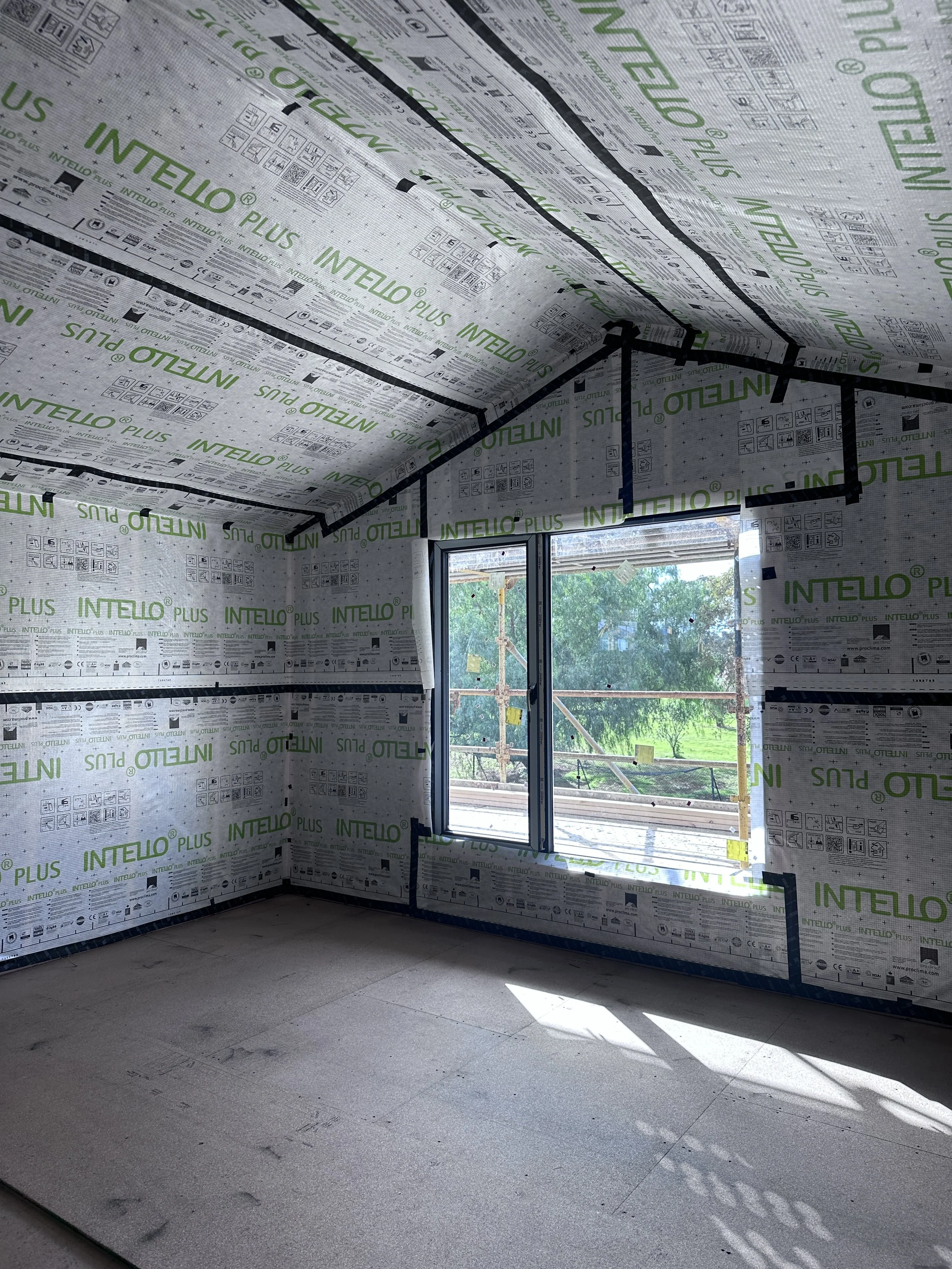
'Water kills buildings', so we pay close attention to stopping bulk water. We use a quality vapour-permeable barrier with all joins taped, working alongside a ventilated cavity.
We use the correct external membranes and tape them correctly.
A Water Resistive Barrier (WRB) is a great tool for moisture management.
-
Achieving a cracking airtight quality is crucial for a high-performance home, minimising outdoor air infiltration and reducing energy losses. We aim for less than 3 Air Changes per Hour (ACH) when tested with a blower door, with all new builds needing to achieve under 1ACH.
It enhances building durability by reducing exposure to moisture and air infiltration.
It limits outdoor pollutants like pollen and dust from entering indoor spaces.
-
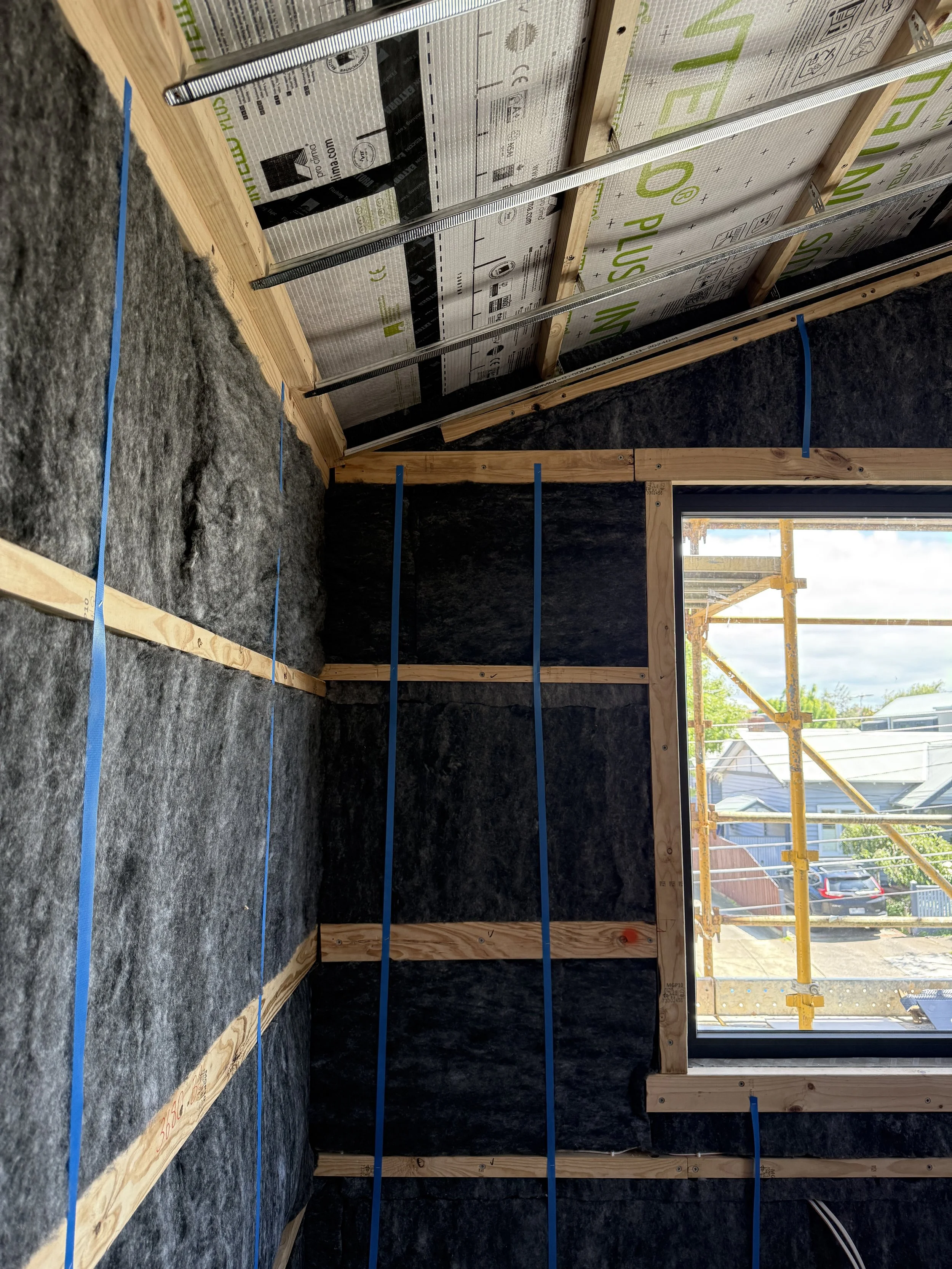
The insulation must be continuous. The thickness is determined by the modelling.
Ceilings: Minimum R6.0.
External Walls: R4.0 in a new home; aim for around R3 in a retrofit.
Foundations: Minimum R2.5 in your slab (including around the perimeter), and R5.0 if you have a timber subfloor.Item description
-
We look for windows with U-values <2.0. This means minimum double glazing with high-performance glass and warm edge spacers, most likely in uPVC, timber, or aluclad frames
They maintain indoor temperatures, which lowers energy costs.
They are designed to optimise solar heat gain for passive heating in winter while keeping things cool in summerItem description
-
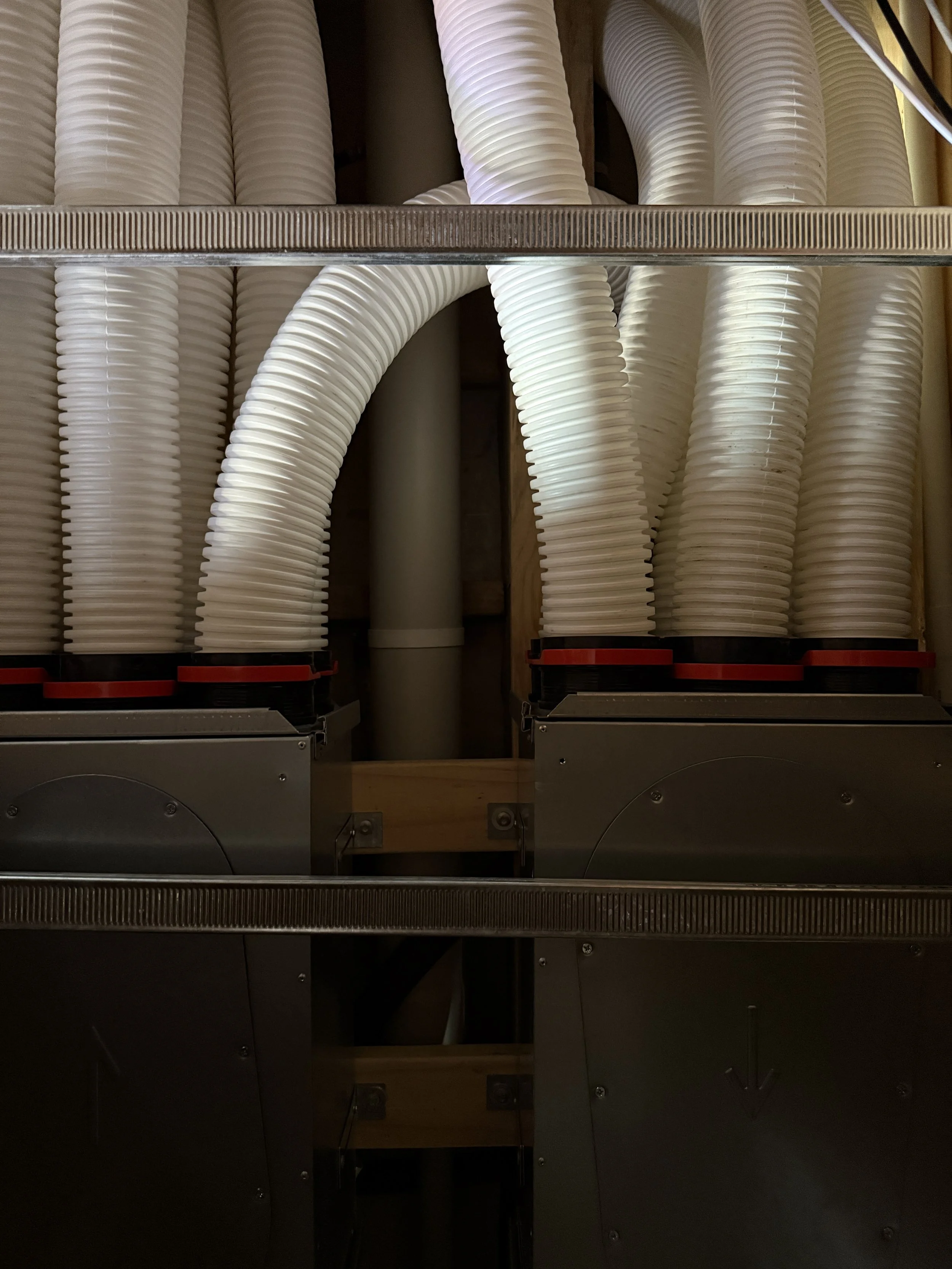
In a super air-tight home, mechanical ventilation helps us take back control of the air. We usually install a centralised Heat Recovery Ventilation (HRV) unit—or an Energy Recovery Ventilation (ERV) unit up north.
It helps filter out the bad air outside, leading to great indoor air quality.
It reduces the risk of moisture build-up, preventing condensation.
It recovers the heat in the house, cutting down on your heating requirements.
-
Reducing thermal bridges enhances energy efficiency by reducing heat transfer.
It prevents condensation and moisture problems.
It improves occupant comfort by maintaining consistent indoor temperatures.
-
Going all-electric helps improve indoor air quality as there is no internal combustion. Electric appliances are also generally more efficient than gas.
We prefer all-electric appliances, preferably with a CO2 heat pump for hot water production and solar panels.
This helps in the reduction of the carbon footprint of the home.
-
Solar panels cut down electricity bills by generating renewable energy on-site.
They lower the carbon footprint by utilising clean, renewable solar energy.
When paired with a battery, they can reduce grid dependence and increase energy independence.
Solar panels are a technology, and you shouldn't be relying on them to cut your running costs
-
Verification is vital to ensure the building's design, construction, and performance all align with the specifications.
This includes a blower door test.
We do a thermal imaging inspection of the insulation.
We also check glazing components and take photo evidence of all stages of the construction.
We test windows are installed correctly by hosing them down
Documenting through photos and evidence to prove construction meets design
High Performance Homes Examples in Melbourne
High performance to us is not new; we have been doing it for years before it was cool. Not all of our projects seek Passive House certification in Melbourne, so we refer to them as High Performance projects. We have strict criteria for what high-performance homes mean. All of the above boxes must be ticked to define it as a high-performance home, so we know our clients can sleep (comfortably) knowing that they are getting what they paid for. Check out some of our high-performance homes, and more coming soon below

Rupert High Performance
West Footscray

Maribyrnong High Performance
Ascot Vale

Chatfield High Performance
Kingsville
What "high performance" actually means at Carland Constructions
Every builder in Melbourne calls themselves high performance now. It's the buzzword of the decade. The problem is almost none of them will tell you what they mean by it, because most of the time there's no number behind the word.
We'll tell you exactly what we mean. Here's the bar every high-performance Carland home has to clear. If a build can't hit these, it isn't high performance. It's just a house with good marketing.
Airtight, and proven with a blower door test. New builds must come in under 1 ACH. Renovations under 3 ACH. Not "we aim for," not "around." Tested, with a number, every time. This is the single figure that separates a real high-performance home from a standard one, and most builders never measure it at all.
Thermally modelled before we build. Every project runs through the Passive House Planning Package (PHPP), the same modelling tool used for full certification. It tells us exactly how the home will perform, and lets us weigh the cost of every change against the performance it buys, so your money goes where it counts.
140mm walls, properly insulated. 140mm external studs to fit around R4.0 wall batts, minimum R6.0 in the ceiling, and insulation under the slab or subfloor too. Standard homes are built on 90mm studs. The extra depth isn't for show. It's what makes the temperature hold and the energy bills disappear.
Windows that actually perform. U-values under 2.0, minimum double glazing with high-performance glass and warm-edge spacers. uPVC, timber or aluclad. We avoid standard aluminium windows, because they leak heat and undo everything the walls just achieved.
Water and moisture managed properly. A quality vapour-permeable barrier with every join taped, working with a ventilated cavity. We use the Pro Clima system because, frankly, it's the best on the market. Water is what kills buildings. This is the layer that stops it.
Mechanical ventilation with heat recovery. A centralised HRV unit delivering constant fresh, filtered air while recovering the heat on the way out. No relying on opening a window. We only fit Zehnder units, because we won't put a lesser product in the wall and hope.
Fully electric. All-electric appliances, ideally a CO2 heat pump and solar. No gas.
Passive solar design. The home is oriented and shaped to pull free heat from the sun. We only work with architects and designers who'll optimise for it.
Tested and checked at every stage. Blower door test, thermal imaging walk-through once the insulation's in, proof every window matches the spec, and photographs at every stage of construction. We don't assume it's right. We prove it is.
Why we don't dress it up
Most builders make high performance sound effortless and beautiful, because that's easier to sell. We won't insult you like that. Hitting these standards is hard. It takes more time, more skill, and more rigour than a standard build, and plenty of projects can't or won't reach the bar.
We're fine saying that out loud. We'd rather tell you the truth about what it takes than sell you a soft version and hope you don't notice the difference once you've moved in. Our level of high performance is not the same as the next builder's, and the numbers above are how you can tell.
We don't make it sound pretty for your sake. We let the results do the talking.